

Are Classical Christian Schools Boy-Friendly?
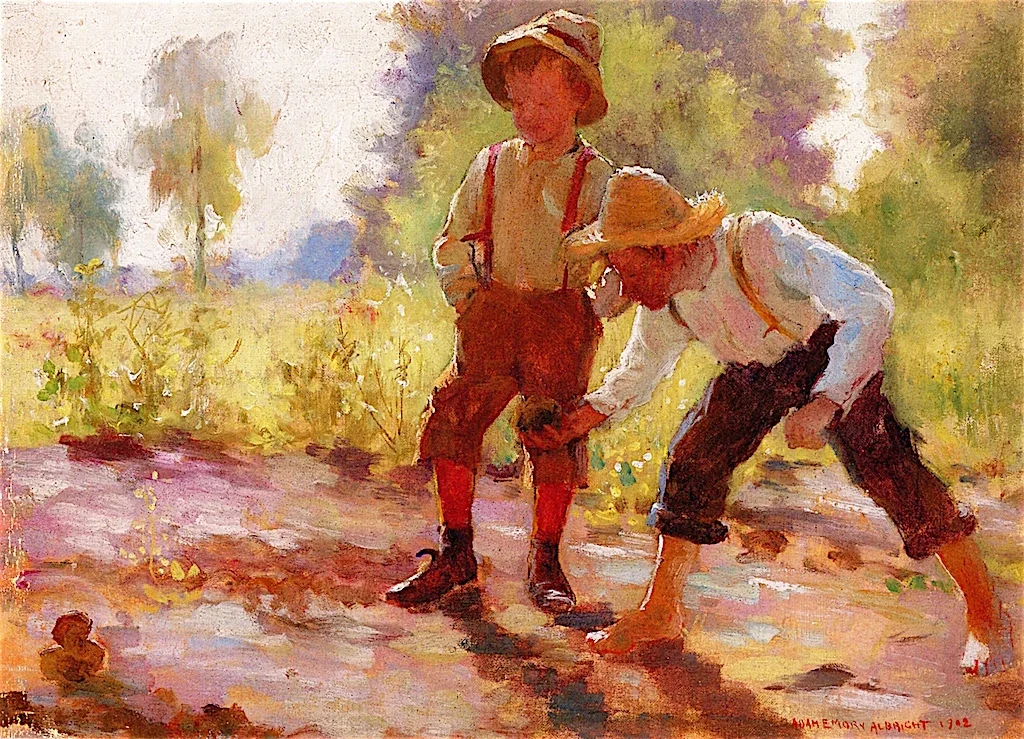
Two Boys Playing by Adam Emory Albright.
I went to an all-male liberal arts college, and I remember an Indiana snowball fight between 50+ brothers from Beta Theta Pi and Phi Kappa Psi. My fraternity brother, Ben, who played basketball, got hit in the eye with an ice ball from a Phi Psi swimmer named Will. He still has vision issues to this day. I distinctly remember them shaking hands and making good while he bled from his eye as if it was no big deal. This story does not condone risky behaviors of boys and men, but it echoes the reality that 3rd-grade boys are the ones that leave the trail on a field trip and jump into the creek. In my college, we only had one rule and it was known as the Gentleman’s rule, “The student is expected to conduct himself at all times, both on and off campus, as a gentleman and a responsible citizen.” What this did was create a culture of character rather than one of mere compliance. Compliance-based regulatory environments work up to a point with boys, but they do not work for future men. After hearing an excellent talk from an administrator at an all-boys 3–12 classical school at a Herzog conference, I am writing here to share some philosophical and practical ideas for working with future men.
First, boys are not problems to be solved. Good teachers understand the tendencies of little boys and develop tactics to mitigate some of their more hazardous tendencies (e.g. walking on the monkey bars). I know of one school where the Rugby coach has taught the boys how to tackle appropriately so that the boys can play at recess. I also know of a female-dominated school where rough sports are eliminated at the first sign of any ‘danger’ among the boys. While we should take steps to remove legitimate hazards, I much prefer the view of Thomas Arnold, an English Headmaster, who added rugby to his overly-intellectual classical school in order to leverage the boys’ drive for competition and risk taking.
Second, vision without action is a daydream while action without vision is a nightmare. Boys need to be taught that vision/contemplation as well as action are both important. Today, boys are either taught to be safe and moderately nice guys who are harmless or barbarians who are perceived as a threat to compliance. If a Christian is to be wise as a serpent and innocent as a dove, the nice guy is all dove whereas the barbarian is all serpent. The beauty is that true manhood is both. Manhood is a chord on the instrument of humanity and many boys are just plucking one of the strings. The nice guy lacks courage to defend whereas the barbarian lacks tact to work collaboratively. One of the things that we learn as children is to not put our hand on a stove because extreme heat is not good for the flesh. In like manner, extremes are not good for human nature; the always-neutral nice guy is an extreme and the overly-macho barbarian is also an extreme. Classical Christian education calls for something more than these extremes. Like Aslan, true men are not safe but they are good. A good man is both a provider and a protector.
Third, let boys be boys, but do not let them stay there. Boys want to climb higher, run faster, spit farther and get into random debates in class. There is a competitive jocularity to the male species. The boys need tactics suited to their tendencies as future men. Observe the boys but do not supervise them. Boys want to be seen but do not want someone looking over their shoulder all of the time. Boys need both expectations and a level of freedom that is suited to their age. A third grader needs more explicit boundaries than a 7th grader. Boys need to be given some leash to endure some risk but given boundaries to prevent real hazards. Sometimes, compliance-focused teachers confuse a manageable risk and a real safety hazard. Boys like to roughhouse and should be given some areas where that is okay within a school day. This requires discretion and teachers should be given discretion on defining right ways to blow off steam. Otherwise, boys reach the end of the day and are brow-beaten for being themselves. Teachers need to learn how to coach instead of control. Coaching is a far better tactic with boys because they want direct instruction yet are not motivated by compliance as much as girls in many cases. What displays as obstinacy as a young boy may display as leadership in middle school.
Fourth, boys should be treated as men but judged as boys. Sometimes we are surprised when boys misbehave, because we are judging them as if they are men. The Bible is clear that boys run on respect, whereas girls run on love. While this may have different applications at different ages, the principle holds throughout all of life.
Fifth, most K-12 classical Christian schools are not all-male yet they should seek to find ways to call the boys to manhood in a compelling fashion. This could be a gender-segregated humanities class on a weekly basis where a male teacher reads Emily Dickinson or Charles Dickens with the boys. They need to see men who love the life of the mind yet also like to hunt and fish and play sports. It may be assigning them a mentor or developing a father-son retreat. It could mean introducing an elective into 7th- and 8th-grade to get them ready for greater levels of freedom in high school. Overall, boys seem less friendly to top-down compliance than girls and need opportunities to exercise their freedom in a good way.
All liberty without order is anarchy whereas all order without liberty is tyranny and soulless compliance. As a classical Christian school leader, I value respect, responsibility, and restraint, and I see that boys need opportunities to learn how to practice self-restraint rather than teachers always doing it for them. When schools and homes agree on the right way to raise boys to manhood, we will graduate more life-ready young men.
I am indebted to the Heights Forum (https://heightsforum.org/) which freely shares their insights on how to instruct boys to become men. The world needs fewer barbarians and nice guys and more Christian gentlemen from our schools.