Foundations for Lifelong Learning: A Review
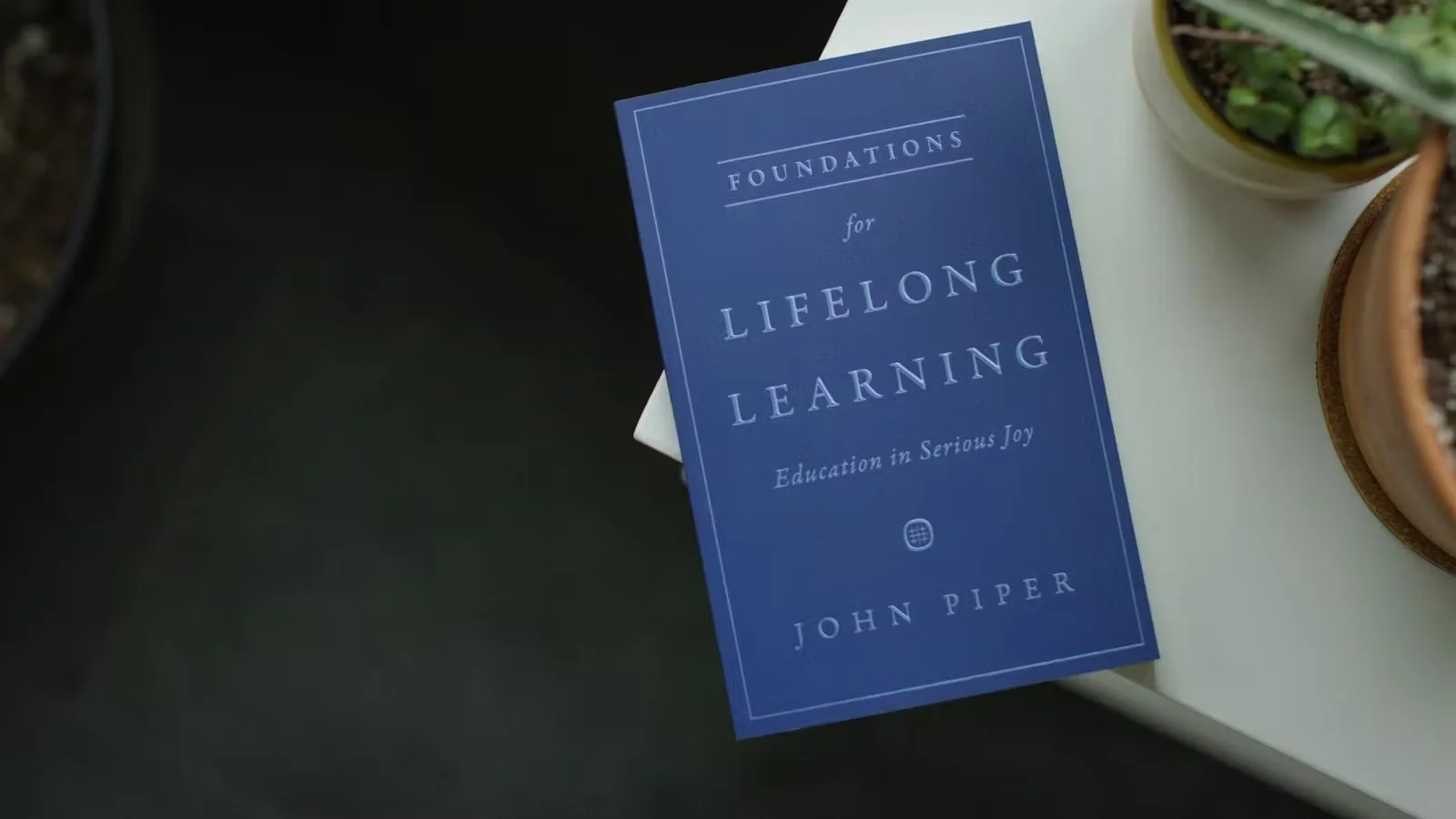
John Piper, Foundations for Lifelong Learning: Education in Serious Joy (Wheaton, IL: Crossway, 2023). 192 pages. Softcover. 978-1433593703. $17.99.
There was once a time not so long ago nor that far way when Calvinistic theology experienced a resurgence, giving rise to the “New Calvinist” movement. This movement swept American Evangelicalism by storm, breathing a doctrinal life into an often vapid and shallow movement. Though the movement has arguably lost its steam and prestige, it certainly has had an indelible mark upon the American religious landscape for good or for ill. One of the figures at the helm of the movement, and notable for faithfulness in preaching the gospel and lack of debilitating scandal, is John Piper.
John Piper was born in 1946 in Chattanooga, TN. The son of a traveling evangelist, he would grow up in Greenville, SC before leaving his sweltering southern home to take up residence in the frigid north. It was in Chicago that Piper received his Bachelor of Arts in Literature and Philosophy and met the love of his life, Noel. From Chicago, he would transition to California to complete his seminary education at Fuller Theological Seminary under Daniel Fuller. From Fuller he would transition to the University of Munich in pursuit of a Doctor of Theology degree.
Thoroughly educated and with both a passion and vision for a God-centered life, John Piper would take up residence in the Twin Cities where he would be a professor at Bethel University from 1974-1980. It was at this point that Piper took up his famed post as the pastor of Bethlehem Baptist Church and where he would remain until 2013. It was during this time that Piper’s star of fame and influence would grow brighter and reach a widening circle of spectators. He founded the organization Desiring God in 1994, has authored over 50 books, and has left his imprint upon a large number of organizations and conferences ranging from the Gospel Coalition to the Cross Conference.
Piper the expositor has not restricted his interests to the pulpit however. The mere existence of Bethlehem College and Seminary should dispel that notion. Additionally, he has put forth his literary labors in the direction of education in his recent book Foundations for Lifelong Learning: Education in Serious Joy. Given the wide reach of Piper’s voice and the intrinsic importance of rightly understanding the form and purpose of education, Piper’s recent book will be of interest to any Protestant classical educator.
Summary
The principal aim of this book is that the reader would adopt and promote “education in serious joy.” Jesus Christ, God and man, Creator and Redeemer, has given us both the book of nature and the book of Scripture that we would glorify God through him by supreme joy in him. In order to attain this end, we must be lifelong learners, whether young or old. Piper notes in the introduction that education, or lifelong learning, is not principally about getting degrees behind your name or acquiring technical skills that enable you to make money. Rather, lifelong learning is about growing “in the habits of mind and heart that will never leave you and will fit you for a lifetime of increasing wisdom and wonder through all the sweet and bitter providences of life.” (p. 12-13)
Those habits that Piper enumerates are observation, understanding, evaluation, feeling, application and expression. First, in order of nature, is the habit of observation. Piper quickly clarifies that the habit of observation he is seeking to define and exposit is not merely observation reducible to the five senses. Humans after all are not merely bodies but ensouled creatures. Thus, observation relates not merely to what you see, touch, and hear, but the spiritual analogues of those faculties. After all, we are to taste and see that the Lord is good. We are to be open to reality and not unobservant idealogues. We are to observe ourselves, those around us, the world, and the Word.
From observation comes the habit of understanding. Piper defines understanding in terms of seeing how things fit together in order to give a valid conclusion. As Piper notes that understanding or reasoning is baked into the very fabric of our experience in this world. This same reasoning is very apparent in the pages of Scripture. In order to meaningfully understand the world and the Word, we must employ our reasoning.
It is at this point that he gives a thick defense of formal logic. Rather than being a false philosophy imposed upon credulous Christians, formal logic is a universally valid science that is essential to rationality and life in God’s created cosmos. Rather than being grounded upon mutable humanity, it is grounded upon the immutable God, who is himself the source of its life-giving potencies.
Next, Piper considers the habit of evaluation. By this he means the capacity to “make judgments about the truth or goodness or beauty or worth of what we have observed and understood.” (p. 73) Humans are not amoral brutes of the field. We are not neutral onlookers, but moral agents who are always disposed either towards the true and good or towards the false and evil. Further, the argument for making correct evaluations is buttressed by its intrinsic power to honor God, serve people, and lead to joy.
Evaluation supposes a rule. A rule according to which one judges whether an action, idea, or person is conformable. God himself as revealed in the world and in his Word is that rule. Hence we must habitually be those who seek to make correct evaluations. Evaluations which are measured by God, the absolute standard. But we must not only give correct evaluations, but fair evaluations. This is where the habit of understanding comes in. We cannot evaluate fairly unless we have engaged in the “dangerous work of understanding.” (p. 83) We must accurately and patiently seek to come to terms with an idea or action before we condemn or praise it, lest we evaluate fictions of our own creation.
Education does not merely seek to affect habits of intellect in man. “Lifelong education should seek to form the heart with its feelings as well as the mind with its ideas.” (p. 91) Feelings are as essential to humanity as the thoughts of the mind and decisions of the will. Hence the importance of cultivating the habit of feeling that is directed toward proper objects, properly proportioned, and is alive.
Piper quickly clarifies that he is not discussing the physical aspects of feeling however. Under consideration are the morally significant feelings. The spiritual affections as he will term them. Those passions or affections which are either virtuous or vicious. Though all humans can have relatively good affections that secure relational peace horizontally, he is principally concerned with truly good feelings that are vertically pleasing and acceptable to God out of a concern to honor God.
So far, our habits have been intensive. They have focused on a person’s concern for himself. The habits of observation, understanding, evaluation and feeling may all be properly performed inside of a man himself without much external action. It is at this juncture that the habit of application enters. This habit is where we turn “our observation, understanding, evaluation, and feeling into action for the sake of the glory of God and the good of others.” To put it another way, it is that habit whereby we take what we have learned and seek to “turn it into wise and useful action.” (p. 118) We are called not merely to be hearers but doers. We are called not to mere theory but practice.
This application is an overflow of our own joy in God and is the diffusion of love which seeks to meet the needs of others. We are called to live among fellow humans and believers, and this is a signal way whereby God is glorified in this world. God desires that his glory be made known visibly in this world, and thoughtful and pious action for the glory of God in good works is the means.
The capstone to Piper’s habits for lifelong education is expression. The man of the previous habits yet wants one in order to be a truly educated person ready for lifelong learning. This habit of expression is the capacity for “verbal communication of what we have observed, understood, evaluated, and felt through written or spoken (or signed) language.” (p. 137) Expression can be thought of as a subset of application, being application as communicated through word rather than deed. Further, it is a habit in that there is a way that our words should be habitually used. After all, God has spoken to us and words matter. It is through written word and oral speech that men glorify God by moving the minds and hearts of humanity.
Appreciation
John Piper’s book is to be commended on several scores. Just as his ministry is pervaded by an all-encompassing sense of the glory of God in the face of Jesus Christ, so too this treatment of the ends of education is suffused with the beauty of God’s glory revealed through Jesus Christ. This rightly treats education not merely as a “neutral” or “secular” endeavor divorced from man’s chief end. That man’s chief end is to glorify God and to enjoy Him forever means that education is “lifelong learning for the glory of Christ.” (p. 13)
Additionally his conception of education as instilling certain habits both of mind and heart is a necessary corrective to the corrosive tendencies of modern education to reduce the goal of education to mere utilitarianism, information acquisition, or social acculturation. As with the larger classical and Christian tradition, education for Piper is cultivation of mental and moral culture, and specifically fitting our youth with intellectual and moral virtues that rightly order them towards the Triune God and that enable them to seek the good of their fellow man.
Another aspect to appreciate is Piper’s insistence upon this mental and moral habituation through interaction with God’s two books, that of His world and His Word. A truly classical and Christian liberal arts education is one which admits both natural and supernatural revelation and accurately clarifies their relation to one another. Our education is perfectly attained only when we interact with and appropriate the riches of truth and goodness evident in both creation and revelation proper.
Critique
Though it is an overall verity that Piper’s book is both helpful and insightful for a wide-ranging audience, it is also true that there is chaff mixed up with the wheat. One weak spot of Piper’s work is its overall lack of interaction with education in the Western tradition and modern literature concerning classical Christian education. The book would have only been strengthened by interacting with these sources.
Branching out of this critique is the question of Piper’s taxonymy of habits. Admittedly there is something helpful and logical in the movement from a habit of observation to that of application and expression. On the other hand however is that this classification seems insufficient or lacking in clarity. How does this classification relate to the cardinal virtues of prudence, fortitude, temperance, and justice? How do they relate to the theological virtues of faith, love, and hope? Is this grouping conformable to the three acts of the mind: understanding, judgment, and reasoning? It seems to cut against the grain of standard accounts of epistemology and reasoning to place judgment after reasoning. It does not seem like the seven traditional virtues are easily referrable to these habits that Piper discusses. Is moral and intellectual habituation complete without these? Can a truly Christian liberal arts education occur without formation in these virtues? In charity I trust Piper does not exclude these, but without interaction with them one can only wonder.
The last note is a curious comment from the chapter on evaluation. Having related Mortimer Adler’s account of human agreement as grounded in rationality and disagreement as grounded in man’s animality and proclivity to passion and prejudice, Piper states
‘Men are rational animals.’ That is the top-off to the worldview. All we are is rational animals—animals with a higher level of reasoning than the rest of the animals. We do not have souls that are responsible to God and capable of relating to God in joyful submission or proud rebellion… He has no place for sin, which profoundly corrupts and distorts the way we observe and understand and evaluate. (p. 86)
It is questionable whether Mortimer Adler sufficiently accounted for sin in human disagreement. More substantial is Piper’s misunderstanding of Aristotle’s definition of man, which has largely been received by historic and orthodox Christianity.
It's rather ironic this comes after his previous chapters on education as instilling habits of observation and understanding. Perhaps Piper has not duly looked into the history of this definition, but he should duly honor the Christian tradition which adopted this definition. He clearly doesn't understand what Aristotle or the Christian tradition has affirmed by this definition. We all make mistakes in understanding positions we deny, but it appears as though Piper has acted against his own word and avoided "the dangerous work of understanding." (p. 83) Rationality is the specific difference of man when contrasted with other animals. It's not a mere quantitative difference, but a qualitative one. Man is not endued with a mere vegetative or sensitive soul, but endowed with a rational soul. More than beast, yet less than angel. A.I. and other animals, though endowed with the shadow of reason (e.g. power of association, calculation, instinct, etc.) do not possess the capacity to understand, judge, reason, and choose the good by rational deliberation.
Piper elsewhere makes this to be man’s capacity to enjoy God. The capacity of man to delight in or enjoy God is a necessary corollary or essential property of man qua rational animal. You don't have to deny a historic Christian definition of man in order to safeguard against being unable to distinguish man from beast or computer. You can rightly preserve spiritual affections and the capacity to enjoy God while also saying that man is a rational animal. You can have your cake and eat it too.
Conclusion
All being said, Foundations for Lifelong Learning is a valuable and helpful primer on the purpose of education, which is to instill certain habits of mind and heart to the glory of Jesus Christ. Though it has its defects, its particular virtue is distilling many sound principles that go to constitute a well-rounded Christian liberal arts education to a wide audience. May we eat the meat and spit out the bones.