

Raising Sturdy Kids: A Review
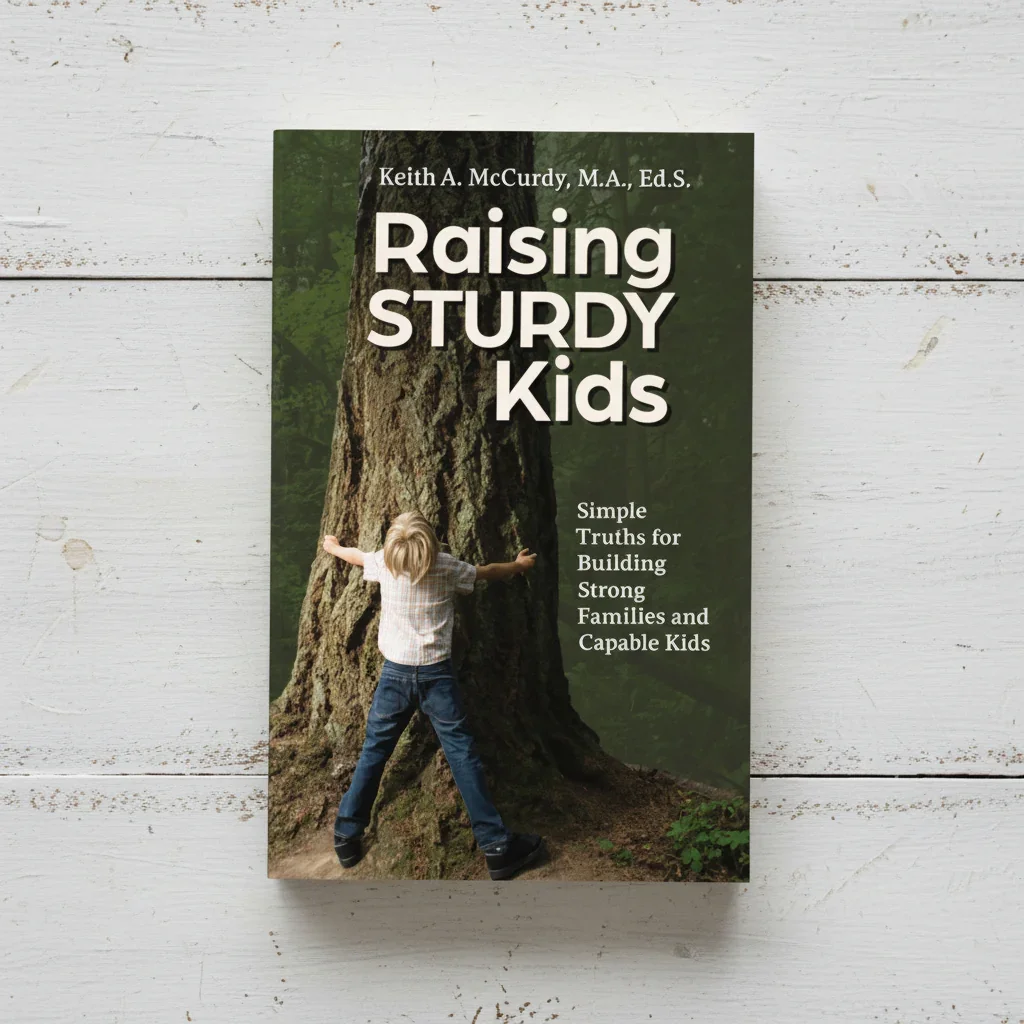
If a parent is new to Classical Christian education, they would be better served reading Keith McCurdy’s new book, Raising Sturdy Kids, than reading one of the many primers seeking to define Classical Christian education. Classical Christian education is more easily detected than defined, yet it is essential that the culture of the home and classroom align. Ideally, new parents would read both, but the value of Raising Sturdy Children is that it equips parents to run their homes the way that Classical Christian schools run their classrooms. At the very end of the book, McCurdy explains why he sent his kids to Classical Christian school, “My kids were not educated in this manner because of something we were running from, but rather because of what we were running toward” (261). McCurdy goes on to explain that Classical Christian education impresses upon the hearts of our children the commandments of God. He shares also that all of the teachers, administrators, coaches, and staff were interested in the development of the student beyond academics. This is the book that every parent at Classical Christian school needs to read, seriously. This book will have the effect of creating a greater like-mindedness and common practice within school communities. Even parents already familiar with McCurdy will be further encouraged and equipped by the book. Raising Sturdy Kids is the mature fruit of someone who has parented faithfully, and counseled others to do so as well in his role as a licensed marriage and family therapist. The book’s clarity is the result of thousands of hours traveling the country speaking to businesses, schools, and teams. What follows are the best ideas from McCurdy’s excellent work with commentary along the way.
From the glossary at the beginning of the book, McCurdy clearly defines a few important terms that are often misunderstood.
Authoritative Parenting: A type of parenting that is characterized by high warmth, high expectations, significant responsibilities, and clear accountability.
Equipped: Able to handle the ups and downs of life well
Gentle Parenting: A parenting philosophy that allows children’s wants and desires to take priority; it frames things as choices and promotes conversations about emotions, but requires few meaningful contributions to the family and does not require demonstrations of responsibility before allowing freedom
Healthy Struggle: When children have to wrestle with choosing to do the right/responsible thing despite negative feelings about it; developing perseverance; ultimately the engine of growth and maturity
Maturity: The courage to do what you know is best or right, even when it is difficult or uncomfortable, or you just don’t want to
Therapeutic Approach/Model/Parenting/Mindset: A philosophy of parenting driven by psychological theory that posits that we are determined by our past, values, subjective experience over Transcendent Truth, devalues historical wisdom holders, establishes psychological professionals as experts on parenting, overemphasizes the emotional world of our children, and has led to the removal of struggle from the lives of our kids.
Rather than simply critiquing therapeutic and gentle parenting, McCurdy gives a positive practical vision for equipping children for healthy struggle to develop maturity grounded in transcendent Truth. Raising Sturdy Kids offers actionable truths for parents without compromising on sound philosophy and theology. The myth is that ‘freedom and privilege should just be given without the contamination of obligation” (41). This book is published by Classical Academic Press and will have appeal to Classical charter schools that are not explicitly Christ-centered so readers should understand that McCurdy’s work has broader appeal. With that in mind, parents should add to their own glossary the all important word ‘gospel’ which is the joyful message that leads to salvation wherein Jesus forgives sinners by giving His life for theirs. To teach and parent from a biblical worldview entails a Christ-centered approach.
In chapters one and two, McCurdy interacts with the myths being peddled to parents and explains what our culture is getting wrong about building sturdy children.
“Would you rather your child be ill-equipped later in life, or uncomfortable now?” (6)
“It appears that the more we have treated and medicated, the more we see a significant decline in the mental health of our children and their ability to thrive in the world.” (12)
“A sturdy kid is one who is able to cope with the disappointments, responsibilities, and freedoms of life with maturity, resilience, and perseverance. She does not wilt before challenges. He has developed strength through healthy struggle. Sturdy kids know who they are, how to they relate to others, and what they have to contribute to the world.” (16)
“Most children do not need therapy; they are just in need of training in character, maturity, and resilience that wise parenting will give them.” (20)
From Phillip Rieff’s book, The Rise of the Therapeutic, “Formerly, if men were miserable, they went to church, so as to find the rationale of their misery; they did not expect to be happy… Freud embarked on a modest experiment: his doctrine promises not more happiness but less misery” (49). McCurdy writes, “Freud took us away from an external focus on the Transcendent to an internal focus on the self, and we ate it up.” Freud wrote, “Religion is an illusion and it derives its strength from the fact that it falls in with our instinctual desires… I regard myself as one of the most dangerous enemies of religion” (53).
Everyone has met the student who cannot cope with normal ups and downs of life. This section in Raising Sturdy Kids unmasks the shortcoming of the broader culture’s mental health narrative and how it is not actually helping children grow into capable contributors with established identities. Every child needs to know that they are capable, valuable, and connected to others but children are struggling more despite the increased secular mental health interventions. McCurdy’s boldness in quoting Rieff, critiquing Freud, and showing the bankruptcy of the therapeutic child-centered mindset, is uncommon knowledge at most Classical Christian schools. This is one of the best sections of the book.
In chapters three through seven, McCurdy sets the goals of parenting, emphasizes the priority of marriage, and introduces the important doctrine of Ordo Amoris.
“Would you rather have children who are safe and happy, or capable and equipped?” (76)
“Consider it pure joy when we face trials, as it develops perseverance, and perseverance must finish its work. Perseverance is the ability to stick with something even when it is tough (Paraphrase of James 1:4-6).” (78-79)
“Maturity knows that emotions are unreliable guides.” (82)
“Prepare the child for the path, not the path for the child.” (85)
“Ordo Amoris — Correctly ordering our loves — God, marriage, family, kids, world — we are to love the right things in the right proportion for the right reasons.” (102)
“Another version of this psychobabble at a little later stage of children’s development is the idea of how interpret kindergarten readiness.” (121)
“One year olds cry because of unmet needs. Four year olds cry because of unmet wants.” (124)
“One of the most valuable gifts that we can give our kids is that they are witness to a thriving marriage.” (127)
“Don’t parent by consensus.” (134)
“Parents must be leaders. True leaders must work for the benefit of those we lead, and true leaders should sacrifice for those we lead. Good parenting requires good leadership.” (146)
One of the strengths of Raising Sturdy Kids is that McCurdy begins with the transcendent (or absolute, or normative) instead of pragmatic techniques. Many parenting or classroom management books jump straight into techniques whereas McCurdy goes straight to the reality that good parenting flows out of right relationship with God and spouse. In the list of five priorities, kids are listed fourth. This is thoroughly biblical yet more could be said. After hearing McCurdy speak many times and now reading his work, it seems that his starting point for the live sturdy framework is James 1 which acknowledges the way in which God uses trials to mature believers and develop perseverance. The transcendent grounding of his framework would be richer if Philippians 1:6 were also mentioned, “that he who began a good work in you will bring it to completion at the day of Jesus Christ.” Classical Christian schools are only equipping families from a biblical worldview if there is an explicit connection to the person and work of Jesus Christ. And rightly ordered affections can only occur in a lasting way if a child is reconciled to the Father through faith in the person and work of the Son (John 14:6).
In chapters 8 through the end, McCurdy gets into the warp and woof of raising children in the modern era. He covers technology, tantrums, athletics, autism and medication, and much more. Here are a few valuable quotes:
“Are you raising cruise passengers or a crew?” (151)
The problem with looking inside yourself is that you are left with the simple reality that you are a broken person and that your brokenness is not something you can fix (paraphrase). (157)
“Practical identity formation is a starting point for spiritual identity formation.” (168)
On page 156, an important image is displayed, the Live Sturdy Hierarchy of Service. This alone is worth the price of the book, because it is far more accurate than Maslow’s hierarchy of needs. Maslow’s Hierarchy of Needs has long been needed to be replaced given its unbiblical anthropology and disregard for a transcendent God. Raising Sturdy Kids is more than 250 pages, yet does not need to be shorter in any of the sections. McCurdy has produced a valuable work that would be valuable in any home. It is also written in such a way that parents could jump into one section, not having read the others, and still find benefit. McCurdy’s work is a more robust Christian version of Jordan Peterson’s ‘Clean your room’ mantra. Take care of the little responsibilities first; be faithful over little before the Lord sets you over much. The value of McCurdy is that a brand new parent or a parent with teenagers would both gain from Raising Sturdy Kids. Buy a box of these and give to your friends.