

Groen Van Prinsterer: Politician and Educational Reformer
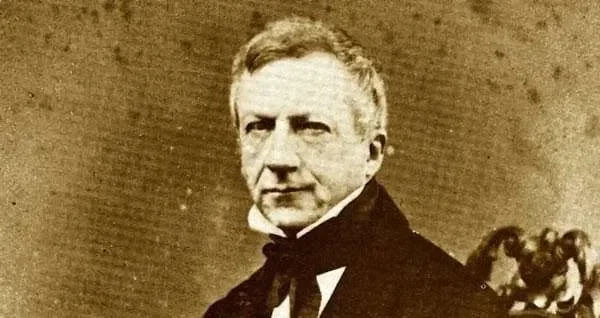
If one has spent any time in the Reformed world, or even in conservative Christianity, they have probably heard the famous quote from Abraham Kuyper: “There is not one square inch of the universe over which Christ does not declare, ‘Mine!’”. Like most good quotes, this is more or less accurate to Kuyper’s original. But, it certainly captures what has become known as “Kuyperianism,” which takes its lead from the Dutch pastor-theologian-newspaper editor-writer-politican Abraham Kuyper (1837-1920). As evidenced by the chain of descriptors, Kuyper had a relentless drive to extend the authority of Christ over every area of life. He eventually was elected as prime minister of the Netherlands–a rare feat for a theologian! What is less well known is that Kuyper was not the progenitor of this approach. He was actually inspired by the work of another Dutch Reformed theologian-writer-politican, who served as his mentor in his early career: Groen Van Prinsterer (1801-1876). In this sense, Van Prinsterer deserves to be known as the god-father, or grand-father, of Kuyperianism and of the entire Neo-Calvinist movement. This article will briefly recount the highlights of Van Prinsterer’s life and work, and a subsequent article will summarize his theory of Revolution.
Van Prinsterer was born into the upper levels of Dutch society. His father was a well-respected physician. Groen excelled in academics, and earned a double-doctorate, in both classics and law, defending both doctoral theses in one day! His dissertation in classics focused on Plato. Although raised in a religious home, Van Prinsterer did not take this seriously until later in life. After a short time practicing law, Van Prinsterer gained a place in the cabinet of King William I. He was later appointed to the post of official editor of the historical papers of the royal family. Groen devoted himself to this painstaking work for many years. He came to believe that God had used kings of the Netherlands to promote the Reformed faith, and that the royalty still had a duty to preserve the unique place of the Reformed church in the life and culture of the Netherlands.
Although Van Prinsterer and his devoted wife Betsy never had children of their own, they mentored others and cultivated deep friendships. Betsy, in particular, was a mother-figure to many. While traveling abroad in Switzerland, they sat under the preaching of the noted Reformed pastor Merle d’Aubigne. D’Aubigne was a member of the Réveil, a trans-national movement of spiritual intensity and practical application of Biblical principles. This is one of the influences that caused Van Prinsterer to make orthodox Reformed Christianity the center of his life, work, and worldview.
At this time, the embers of the French Revolution were continuing to smolder in France and throughout Europe. The forces of Enlightenment and Revolution were challenging the old ways in religion, culture, the arts, and politics. Van Prinsterer ran for public office and was elected to the Dutch parliament. He served off and on for several years. There, he made a name for himself as a staunch opponent of liberalism, secularism, and Revolutionary ideas. Eventually, he gathered others around him and formed the “Anti-Revolutionary” party. Though this group never enjoyed wide-spread popularity during his lifetime, he played the part of a modern-day Athanasius, standing contra mundum as the Netherlands progressed further into the modern era and further from its Reformed and covenantal roots.
We can learn one lesson here from Van Prinsterer. However fiercely he debated his opponents in public or in print, he privately cultivated sincere friendships with those on the other side. We see his true Christian love and concern for his political opponents in his private letters to them. As we fight for the truth in our own context, let us also be known as those who seek to “win the man, and not the argument,” as the evangelist Jim Wilson always put it.
One of the hills Van Prinsterer chose to die on was the issue of Christian education. The Netherlands had been a Reformed Christian society for many years. The southern provinces split away to form the Catholic-majority country of Belgium. There was pressure to make the Dutch public schools more “inclusive” and downplay the Protestant faith in order to focus on a “neutral” morality that Protestants, Catholics, and Jews could all assent to. Van Prinsterer saw this as a betrayal of the country’s heritage. He rightly saw that the pursuit of neutrality would inevitably lead to the abandonment of any semblance of religion in the schools. Therefore he spoke, wrote–and then wrote some more–on this topic. It became his soap-box and many in his circles wished he would just drop the subject and move on with the times. Although he was not able to persuade many in the halls of power, his words did resonate with many throughout the Netherlands. Thus was born the private Christian school movement in the Netherlands, which continued to grow under his inspiration. He never took on the formal role of “leader” of this movement, but the extent of his influence is shown by the fact that the Christian School Association placed a plaque of commemoration at his grave.
Although often misunderstood, maligned and isolated in his own lifetime, Van Prinsterer has been vindicated by subsequent events. Those, like Abraham Kuyper and Herman Bavinck, who took up his cause after him continued the work and built on the foundation he had laid. His bold criticism of the logic of unbelief and its effects on culture and society proved remarkably prophetic. His principled stand against the currents of unbelief in his own time should continue to inspire us as we continue the work of Christian education.
(Note: to learn more, Roel Kuiper’s The Antirevolutionary is the only full-length treatment of Groen Van Prinsterer currently in English.)